
The capacity to mount stone tools in or on a handle is considered an important innovation in past human behaviour. The insight to assemble two different materials (organic and inorganic) into a better functioning entity indicates the presence of the required mental capacity and technological expertise. Although the identification of stone tool use based on microscopic analysis was introduced in the 1960s, distinguishing between hand-held and hafted tool use has remained a more difficult issue. This volume introduces a methodology, based on a systematic, in-depth study of prehension and hafting traces on experimental stone artefacts, which allows their recognition in archaeological assemblages. The author proposes a number of distinctive macro- and microscopic wear traits for identifying hand-held and hafted stone tools and for identifying the exact hafting arrangement. Tested hafting arrangements vary according to the articulation between stone tool and handle, and to the raw materials and fixation agents used. Tool uses include various motions and worked materials. This largely experimental investigation concludes in a blind testing of the reliability of the method itself, showing that a wider application of the designed method has the potential to contribute significantly to our understanding of technological changes and evolutions and past human behaviour.
Aanbieding!
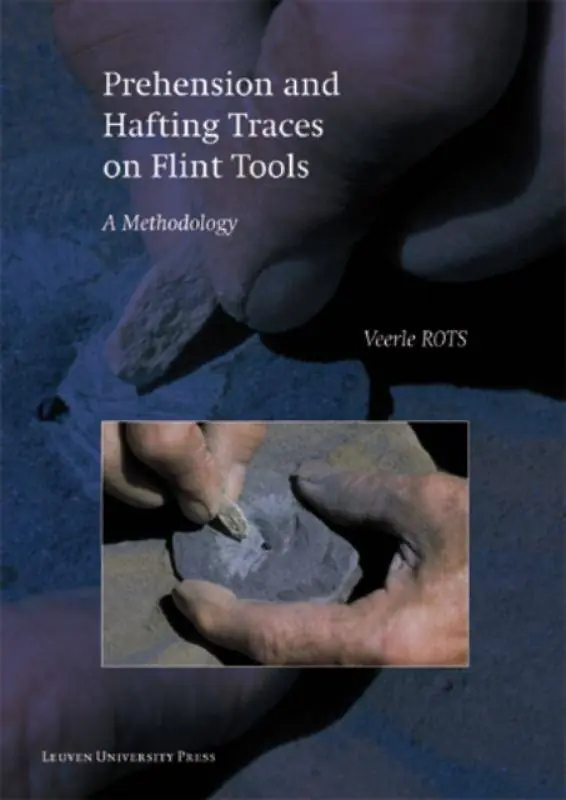
Merkproduct Prehension and Hafting Traces on Flint Tools / 1st Edition
Oorspronkelijke prijs was: € 69,50.€ 34,75Huidige prijs is: € 34,75.
Verzending
Gratis verzending vanaf € 36,00
Voor bestellingen vanaf dit bedrag
Afrekenen
Veilig afrekenen
SSL beveiligde betaalpagina
BETAALMETHODEN

Specificaties
ISBN:9789058678010
Uitgever:Universitaire Pers Leuven
Auteur
Veerle Rots
Druk:1
Pagina’s:273
Taal:English (US)
Verschijningsjaar:2011
NUR
Archeologie